UAE Archives — Carrington Malin

June 20, 2025
emoji-image.png

The biggest barrier for AI First channels to overcome is a human one: trust. People are now, for the most part, willing to accept that AI can be useful, but there are plenty of things that they won’t trust it with. This is not because they are not comfortable with accepting the perceived risks of AI, but in commercial use, conversational AI has clearly failed to meet expectations.

At least two-thirds of consumers would prefer to seek human assistance over any automated service.

New research from ServiceNow sums the situation up quite nicely. A survey of 1,000 UAE residents found that 76% of consumers recognise the importance of a good chatbot service. However, respondents were also asked to rank their first choice of support channel according to their mood (for example calm and focused, or impatient and frustrated etc.). At least two-thirds of consumers – across all types of moods – would prefer to seek human assistance over any automated service.

This is an issue of trust. In the same survey, people were asked what they would trust an AI chatbot with. The most popular answer was ‘Tracking a lost or delayed package’, but with only 24% of respondents admitting that this is something they would trust a chatbot to do.
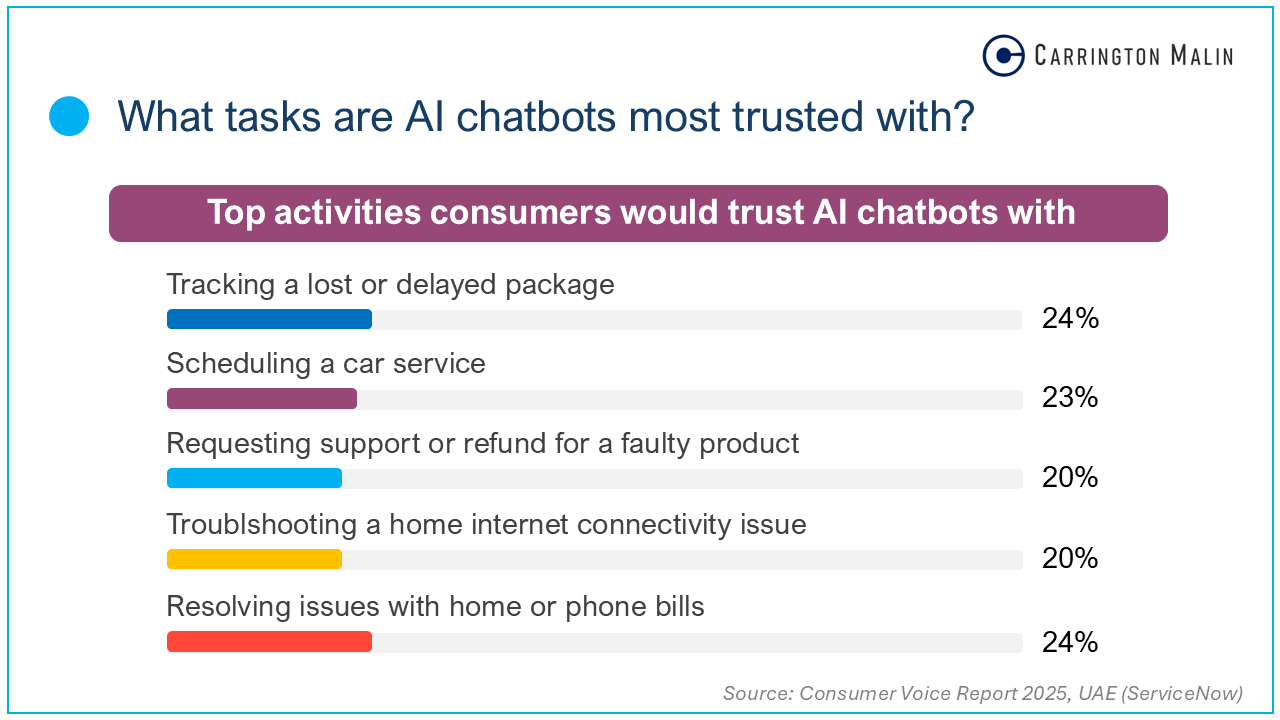
What tasks are AI chatbots most trusted with?

Unrealistic expectations?

Conversational AI clearly has a long way to go before consumers will trust company chatbots or voicebots, but this doubt remains in the face of enormous optimism and positivity towards AI in general in the UAE. The sentiment towards conversational AI in customer service provides a stark contrast to the attitudes of consumers towards the use of AI in daily life and their use of virtual assistants.

Another new survey on attitudes towards AI, this time from Melbourne Business School and KPMG, found that 86% of UAE respondents accept or approve of AI, with 65% confirming that they are willing to trust AI. So, it would seem that business has a problem. Even in a country as overwhelmingly optimistic about the benefits of AI, with rising levels of trust in the technology, businesses are still struggling to build that trust in their own conversational AI channels.

58% of respondents already expect that company chatbots should be able to respond differently according to their mood.- ServiceNow

It would also seem that the near ubiquitous use of ChatGPT and other virtual assistants is proving to be a mixed blessing for AI’s use in customer experience. OpenAI‘s ChatGPT, Google Gemini, X‘s Grok and others have been instrumental in raising expectations for how commercial conversational AI channels should behave and how they should respond to consumers: some would say to unrealistic levels! In ServiceNow’s UAE survey, 58% of respondents already expect that company chatbots should be able to respond differently according to their mood.

GenAI is becoming indispensable

On the plus side, the UAE’s enthusiasm for GenAI has meant that consumers are becoming a lot more comfortable communicating with AI in general, and many are adopting virtual assistants as their go-to channel for a variety of tasks from Internet research, to writing emails and generating business documents, to comparison shopping.

In fact, this month’s UAE Retail Report 2025 from global payment platform Adyen informs that 70% of UAE consumers have used ChatGPT or similar AI assistants to help them with shopping (more than double the 34% average across EMEA). The report also notes that the use of AI assistants for shopping by UAE consumers has surged 44% since 2024.
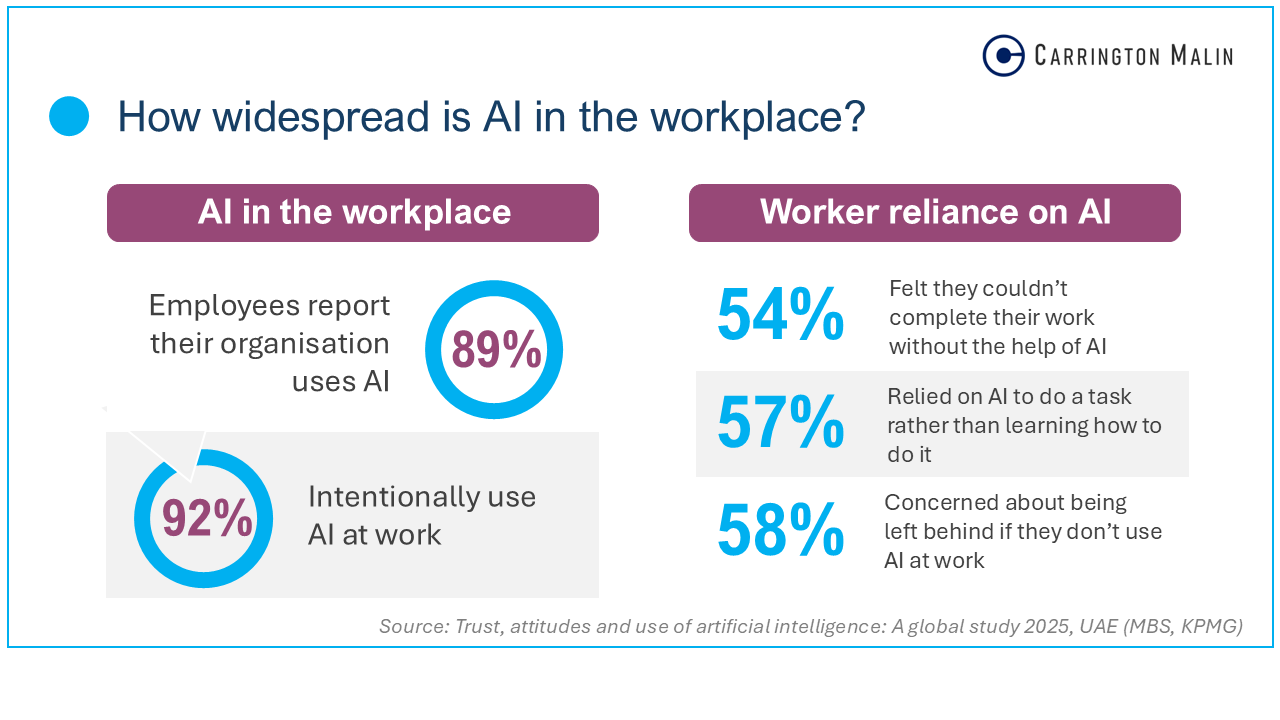
Ho widespread is AI in the workplace?

This means that are growing numbers of people using conversational AI on a daily basis. The KPMG report found that 92% of office workers in the UAE intentionally use AI at work, while 54% felt that they couldn’t complete their work without using AI! This usage also takes place in the knowledge that there are risks that come from using AI. Of those surveyed, 75% were concerned about negative outcomes from AI and 64% admitted that they made mistakes in their work as a result of using AI.

A question of value

Therefore, it would appear that even with the knowledge that using AI comes with certain risks, most consumers are still comfortable in using virtual assistants to help them, and are using them for more and more different tasks. Why? Well, why does anyone take to using anything that has attendant risks? Because consumers believe that the perceived value outweighs the perceived risks. I would argue strongly that consumers tend to avoid company chatbots when they can because they don’t believe that the perceived value outweighs the perceived risks.

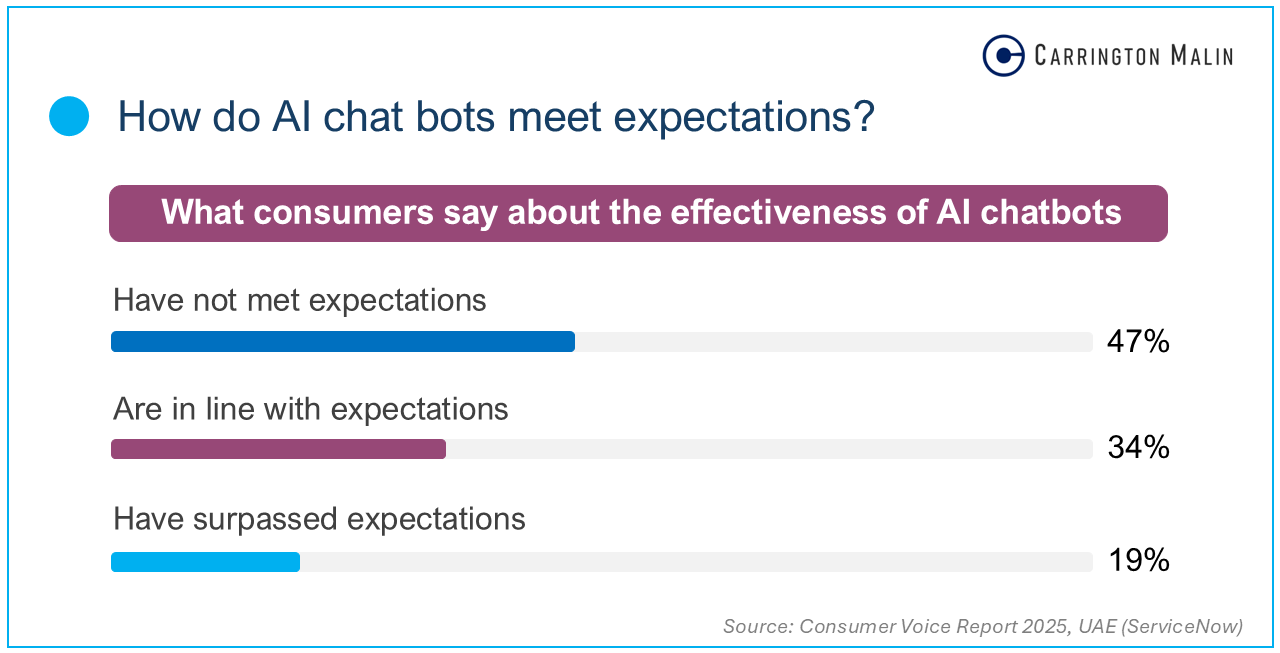
When ServiceNow asked survey participants what the top barriers were for consumers in using AI chatbots for customer service, 93% agreed there were barriers. Although, when asked what their top barrier was, no one reason accrued more than a 14% vote (which was ‘They struggle with complex tasks”). So it looks very like the main barrier could simply be not meeting increasingly high consumer expectations. 47% of UAE respondents confirmed this, agreeing that the effectiveness of AI chatbots had not met their expectations.
How do AI chatbots meet expectations?

In the same survey 34% said that the effectiveness of AI chatbots had met their expectations, and encouragingly 19% said that effectiveness had exceeded their expectations. The fact remains though, that if almost half of your customers believe that you have failed to meet expectations, you have do have problems!

If almost 50% of your customers believe that you have failed to meet expectations, you have do have problems!

Rising consumer expectations are a fact of life for big brands, service providers, retailers, public authorities and many other kinds of organisation that must provide a positive customer experience. However, the comparison between free-to-use GenAI assistants and commercial chatbots and voicebots is hardly a fair one, but it’s one that is impossible to erase from the minds of consumers. The consequences of ChatGPT failing to meet expectations once and a while, are almost zero, but in a commercial environment, failing to handle a customer enquiry appropriately can end the relationship and so have a financial cost.

Raising the bar

It is clear then, company chatbots shouldn’t try to become general purpose tools like ChatGPT, because the risks are too great. It is also clear that the value proposition for most company chatbots is not clear and a common perception is that they are the poor, awkward, error-prone relation of human-to-human customer service. Despite using one of the most advanced customer service channels ever deployed in commerce, the majority of conversational AI simply has no ‘wow ‘!
How positive are UAE residents about AI?

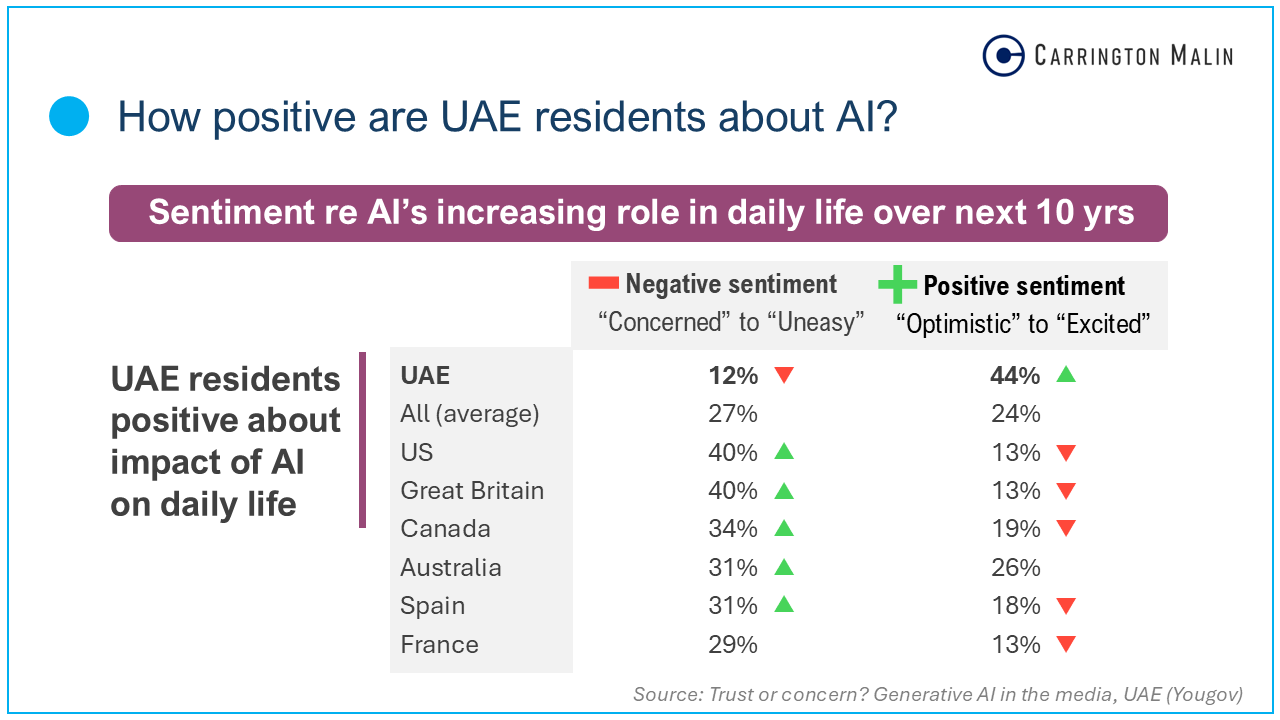
The failure of chatbots and voicebots to meet consumer expectations is not a UAE, or a regional, problem. Organisations worldwide are faced with similar challenges. However, organisations in the UAE may have distinct advantages over counterparts in other geos, in particular Europe and north America. In a new global YouGov survey, the Emirates is markedly more positive about AI than Western countries and getting more so. The UAE’s optimism and acceptance towards Ai arguably make it the ideal testing ground to innovate, iterate and develop conversational AI services that raise the bar.

LINKS

This article first appeared in my June 2025 AI First newsletter.

June 10, 2025
agbi-08Jun25.png

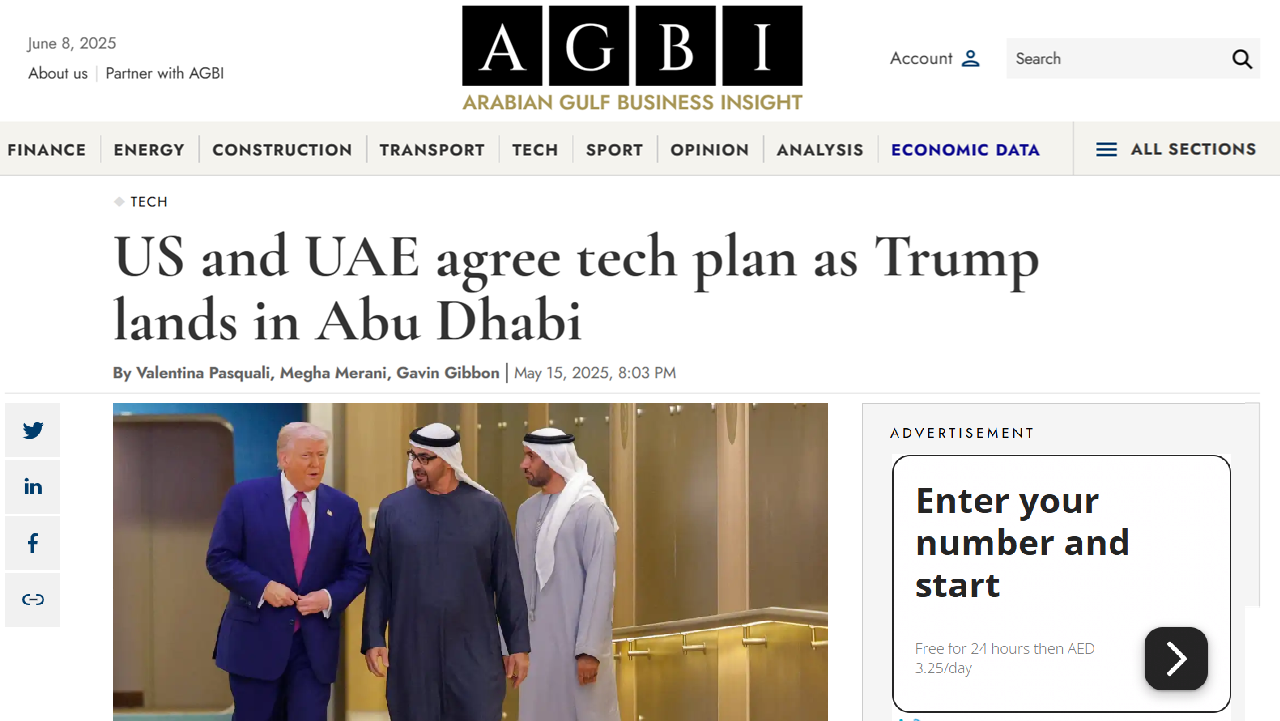
The Trump administration has reversed US policy on export controls for advanced AI processors, although details have yet to be finalised.

Arabian Gulf Business Intelligence (AGBI) asked me to comment on the US-UAE AI Acceleration Partnership announced during the UAE visit of President Trump.

The United Arab Emirates and the United States announced during Trump’s visit that they will establish a regional artificial intelligence technology cluster in Abu Dhabi, together with a 5 Gigawatt (GW) capacity data centre,

The change in US policy is an about turn, with the Trump administration working to find ways to facilitate US AI exports and maintain its technology leadership, rather than restrict the flow of US advanced technology as seemed to be the focus for President Biden’s administration.

Read the full story on Arabian Gulf Business Intelligence here.


September 1, 2023
agbi-g42-hpc-31aug23-1280x719.png

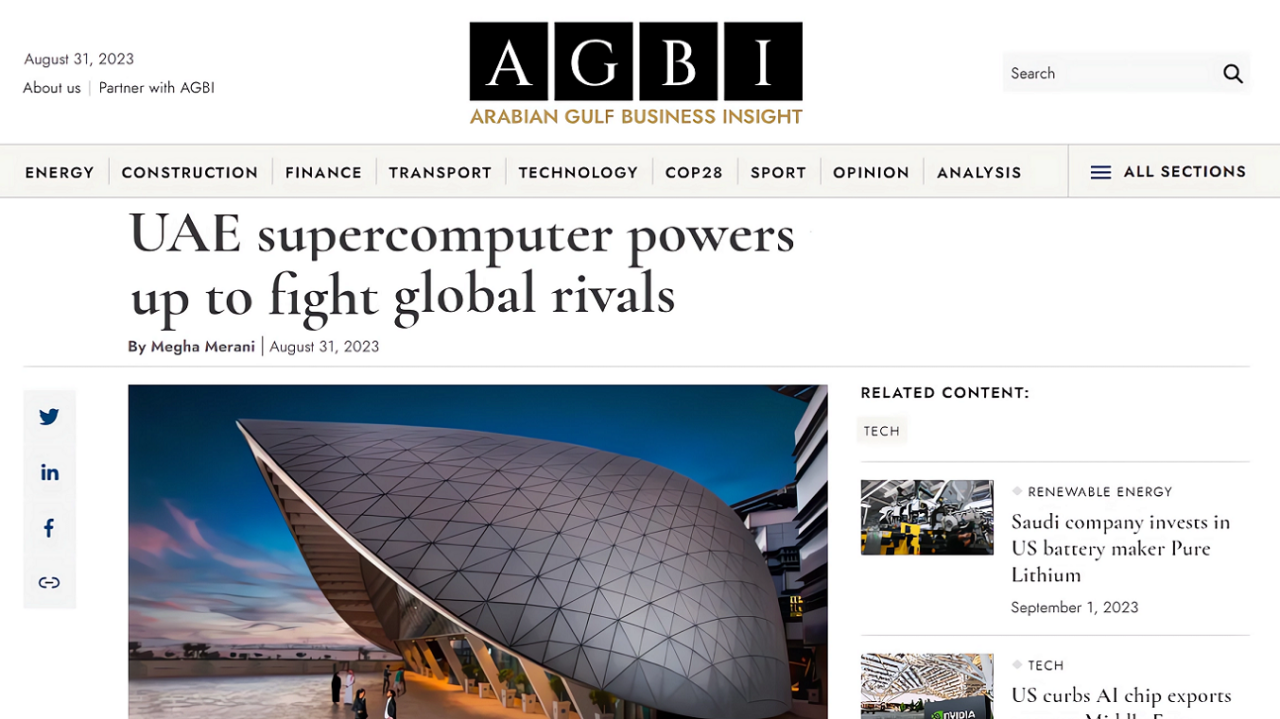
G42 Group’s Inception, Mohamed bin Zayed University of Artificial Intelligence and Cerebras Systems announced a 13 billion parameter bilingual Arabic-English large language model, trained in just 21 days.

The supercomputer Condor Galaxy 1, developed by US-based AI chip maker Cerebras Systems, and announced just a few weeks ago was recently used to train a new 13 billion parameter bilingual Arabic-English large language model (or LLM) called Jais. It allowed researchers to compete the ‘production training’ of the new AI model in 21 day: a process that could have taken several months on alternative high performance computer systems.

It’s common for LLMs to take months to train, but Jais was trained in just 21 days,”

Arabian Gulf Business Insight (AGBI) asked me to comment on the development and the promise of the Cerebras-G42 collaboration to build the world’s biggest supercomputer network.

It’s actually a complex topic, because of the not only the speed of development of new artificial intelligence models and the AI-friendly high performance computer systems that run them, but also the rapid rise of Abu Dhabi’s AI R&D ecosystem. Abu Dhabi-based researchers have now developed a series of different LLM models, including Falcon 40B, which was ranked first on Hugging Face’s index of open source LLMs earlier this year.

It is no wonder that G42 has decided to invest in the latest supercomputers to provide for the growing need of AI researchers. As a result of the expertised gained, both at home, and via collaborations such as the one with Cerebras Systems, Abu Dhabi technology organisations are gaining world-class capabilities that they could sell globally. The demand for both AI models and the computers that train them is only going to grow!

You can read UAE-based journalist Megha Merani‘s full story in AGBI here.

Meanwhile, you can read my article on Inception’s new Jais 13B LLM here:


August 19, 2023
agbi-18Aug23-1352-1280x715.png

We are moving into a new era enabled by artificial intelligence, with both enormous potential and enormous risk. This makes AI and access to AI technologies a growing geopolitical issue.

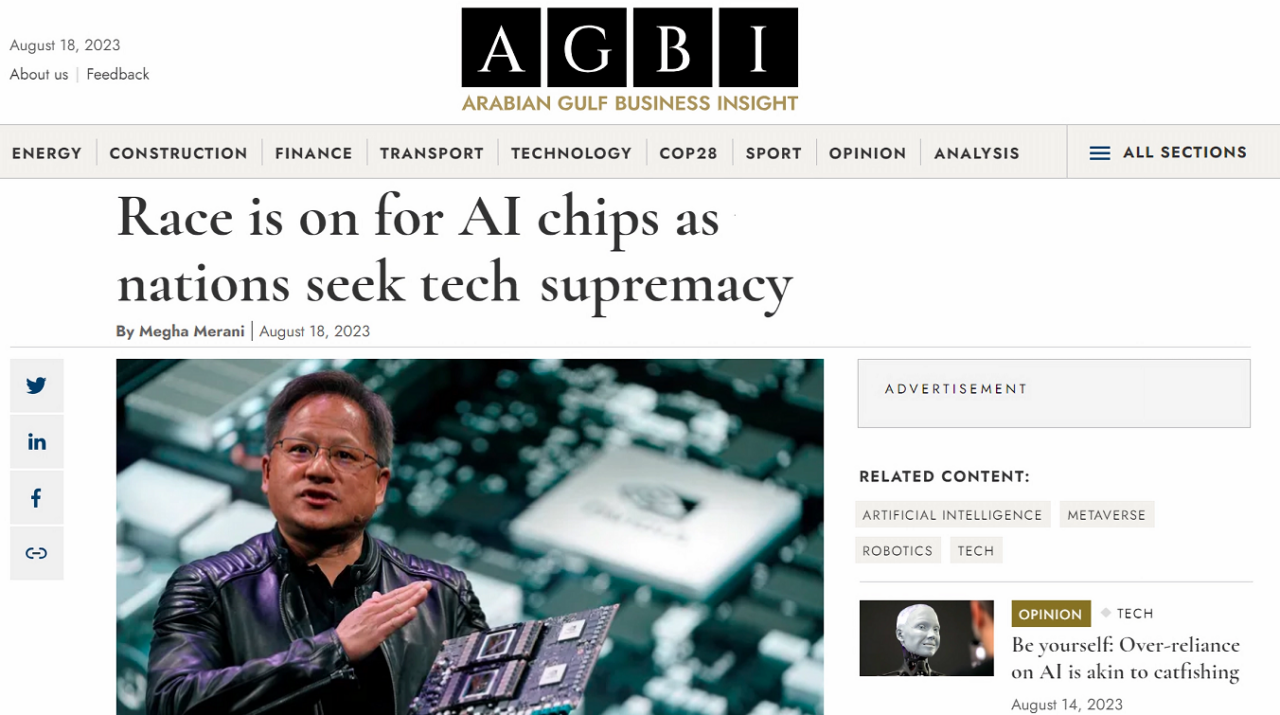
The Middle East is buying a lot of AI chips, but an FT news story, which came close to claiming that Saudi Arabia and the UAE are hoarding processors, stirred up some global controversy!

The focus from Saudi Arabia and the United Arab Emirates on computational research and development across government, national companies and academia, has resulted in an upswing in the demand for high performance computing power. For example, HP is currently building Shaheen III a 100 petaFLOP supercomputer for KAUST (King Abdulla University for Science and Technology). That system alone will use nearly 3,000 NVIDIA Grace Hopper Superchips.

Arabian Gulf Business Insight (AGBI) asked me to comment on the global availability of AI chips, the demands for high performance computing in the Middle East and whether AI chip supply and pricing could become as critical as the oil price. My answer: unequivocally, yes!

The availability, pricing and geopolitics of access to AI chips may well start to look a lot like oil,”

As the world relies on AI more and more. So access to high-end processors will become more and more critical. In that respect, the availability, pricing and geopolitics of access to AI chips may well start to look a lot like oil.

You can read UAE-based journalist Megha Merani‘s full story in AGBI here.


August 8, 2023
times-of-india-07Aug23-1.png

Dubai Centre for Artificial Intelligence could prove to be an ideal hub for global tech founders looking to co-create future technology applications.

I was recently asked for my views on the opportunities for Indian AI startups in Dubai and my answer was, naturally, that Dubai and the UAE as a whole offers great potential for many AI startups. And I’m not just saying that because I’m based in the UAE. The crucial difference between the UAE and many other countries, is that it not only ‘talks the talk’, but it also ‘walks the walk’!

I am frequently find myself impressed by how fast the government moves to create new programmes that help its AI policies gain traction. Teams in government departments across the country are actively looking for the most innovative AI technologies and solutions all the time. So, if you’re the founder of an AI startup that solves a new problem for government, public services or national issues in general, there’s going to be someone, somewhere in a government department that would like to talk to you.

The UAE holds great potential for many AI startups, most of all because the government actually ‘walks the talk’!

The recently created Dubai Centre for AI, which was announced in June 2023, hopes to accelerate Dubai government efforts even further. The new centre has already organised innovation programmes in 30 different government entities to identify AI use cases and implement solutions. Meanwhile, in July the Dubai Future Foundation launched a programme to encourage pilot schemes for generative AI tech in government departments.

The UAE is, no doubt, a fiercely competitive technology market and developers do need to ensure their plans are grounded in reality. However, for the foreseeable future, there is that opportunity to engage with enthusiastic government departments and authorities that are on the lookout for new, innovative approaches.

You can read UAE-based journalist  Megha Merani‘s full story in The Times of India here.


January 16, 2023
dubai-plans-to-create-30-unicorns-by-2033.png

In early January 2023, Dubai Economic Agenda ‘D33’ was approved by Sheikh Mohammed bin Rashid Al Maktoum, Vice President, Prime Minister and Ruler of Dubai. Among the economic goals, Dubai aims to create 30 unicorns (normally a startup valued at $1 billion or more) by 2033.

I was asked by MEED, a leading Middle East business intelligence service, to comment on whether it is possible for Dubai to create a unicorn almost every year and how this might be achieved..

Dubai has never been afraid of setting bold goals and has gained a reputation for meeting them, more often than not. However, creating 30 companies valued at $1 billion in just 10 years? Is that possible?

Globally, unicorn startups tend to be early movers in the biggest new tech sectors. To become a unicorn startups must find a way of tapping into or creating a new fast growing market that will make an impact on a global scale. Such startups are formed by risk-takers that are able to scale their companies very quickly, and that can attract enough venture capital funding to make that possible.

A big plus in Dubai’s favour is that it has been actively seeking out and targeting the most promising future economy sectors and building programmes into its economic plans. Recent initiatives aim to encourage new, fast growing companies in artificial intelligence, robotics cryptocurrency, blockchain and metaverse technologies. It is early days, but sectors such as these are among the world’s fastest growing.

The city also provides an evironment where international businesses thrive, located at the crossroads of Africa. Asia and Europe, with world class business facilities. Dubai was recently ranked first regionally and fifth worldwide in the World’s Best Cities report 2023, which ranked the best global cities to live, work, invest and visit.

“Venture capital in the region has always concentrated on the near term, forcing deep technology (deep tech) startups to leave the Middle East in order to get funding. Dubai will need to attract investors that have both the vision and the expertise to invest in deep tech.”

So, Dubai is ideally located to target some of the fastest growing regions of the world. has a reputation for entrepreneurship and is a great place to live, work and invest. So, what’s missing?

In my mind, the missing piece of the puzzle could be the venture capital to fund the type of cutting-edge startups that will become unicorns. The Middle East region has always been a little conservative when it comes to investing in tech ventures. Although things are changing fast, it is often the most forward-thinking startups that are passed over by VCs in the region. To support a volume of startups in the world’s fastest growing new tech sectors, Dubai will need to encourage the investors that are focusing on those new sectors too.

If you are a MEED subscriber, you can read Jennifer Aguinaldo’s full article here.


January 24, 2022
tech-in-2022-zdnet-24Jan22.png

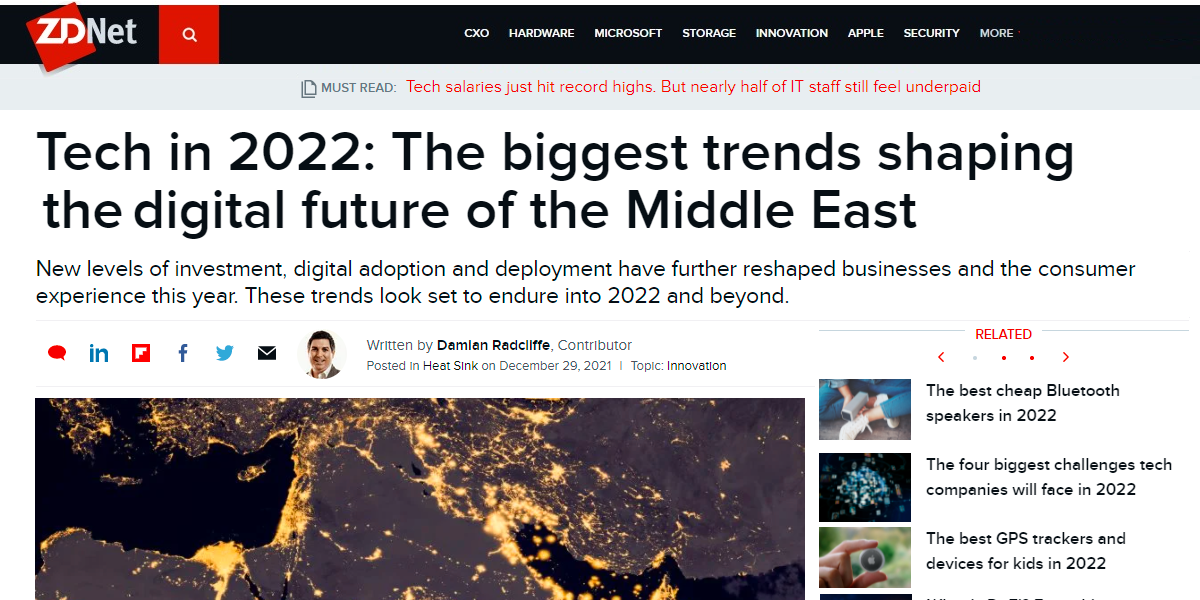
GCC tech in 2022: another big year for innovation? Last year saw a long list of government initiatives in the GCC to accelerate digital transformation, encourage innovation in government and create policies to encourage Fourth Industrial Revolution industries. Recently, I was interviewed by ZDNet’s Damian Radcliffe for his article on ‘the biggest trends shaping the digital future of the Middle East‘.

I have no doubt that 2022 will prove to be an exciting year for artificial intelligence and emerging technologies in the Middle East. There have been so many government initiatives, policy moves, proof of concepts and trials across public and private sectors, not to mention investments in new ventures and R&D over the past year, it’s difficult to simply keep track of the developments already in motion! However, I believe we’ll have plenty of new ventures, projects and initiatives to look forward to in 2022 too.

However, beyond the addition of more impressive sounding new government initiatives, I believe that we’re going to see more real evidence of initiatives and programmes set in process during the past 2-3 years bearing fruit. For example, the UAE published its first AI strategy in 2017. Now, nearly five years on, the strategy (which has been updated a number of times) has informed the launch of new initiatives across UAE education, skills development in government, investment, new projects and new organisations, public services and regulation. In Saudi Arabia, the progress made on data and AI at a government level, has paved the way for a new wave of government and private sector initiatives, companies, partnerships and investments.

As Damian’s article helps to illuminate, there are rapid changes taking place across the Middle East’s tech and telecom ecosystems, making the region an exciting place to be at the moment.

You can read Damian’s full article on Tech in 2022 in the Middle East region here.


July 13, 2021
The-rise-of-AI-diplomacy-expo-2020-dubai.png

AI diplomacy has added a new dimension to international relations and the United Arab Emirates is working hard to build bilateral ties that boost its AI capabilities. It’s also using its AI successes in government and forward looking AI policies to enhance its international reputation.

The UAE’s appetite for artificial intelligence is plain to see for anyone browsing its daily news media. The country’s leadership was one of the world’s first to identify AI as a top priority for government planning and policy, announcing the UAE’s national AI strategy in 2017 and appointing the world’s first minister for AI.

This focus at the top has helped make AI a priority across business, education and the whole public sector. These days, the prospect of AI seems to be embedded into every government programme, public initiative and commercial deal.

It has also now become commonplace to see diplomatic communiqués that mention artificial intelligence. It seems, AI diplomacy is on the rise. The UAE’s foreign relations meetings and forums over the past few weeks with Azerbaijan, Japan, France, Greece, Luxembourg and others have all touched on artificial intelligence.

The GCC has always relied on foreign technology firms and so technology has always had its place in the region’s diplomacy. Over the past few years, the AI race has brought new focus to technology in foreign policy, in particular after the arrival of the Covid-19 pandemic.

Israel-UAE tech collaboration on the fast-track

The historic agreement to normalise bilateral relations between Israel and the UAE last August became the diplomatic event of the year. The agreement considered many economic, trade and security issues: cooperation in energy, water and developing a coronavirus vaccine were pinpointed at the time. However, much of the engagement between the two countries that followed has been tech-centric. In fact, the UAE’s minister of state for AI, Omar bin Sultan Al Olama, last year called the new technology collaboration between Israel and the UAE an ‘undeniable need’.

Shortly after the accord was signed, Abu Dhabi-based AI firm Group 42 announced the opening of a wholly-owned subsidiary in Israel, following memorandums of understanding with Israel Aerospace Industries (IAI) and Rafael Advanced Defense Systems Ltd., and this year formed a joint venture with the latter. The group’s Mohamed bin Zayed University of Artificial Intelligence (MBZUAI) signed an agreement Israel’s Weizmann Institute of Science to create joint AI research and development programmes.

A number of other significant partnerships were signed between Israeli and UAE business groups in 2020. Businessman Abdullah Saeed Al Naboodah partnered with Israeli venture capital giant OurCrowd to form Phoenix Capital, a $100 million fund to back technology investments between the two countries. Meanwhile, the UAE’s in-person tech trade events have seen planeloads of Israeli businessmen attend over the past year.

However, it would be a mistake to assume that the UAE is inclined to ‘put all its eggs in one basket’. The Emirates has a long-standing policy of building bilateral relations with almost all countries across the world, but AI diplomacy has given some of these new purpose. Reem bint Ibrahim Al Hashemy, the UAE’s Minister of State for International Cooperation, recently described Finland as one of the country’s most important partners in innovation and artificial intelligence. The UAE also seems to have stepped up engagement with Estonia on the back of the Baltic state’s success in leveraging big data and smart systems.

China-UAE relations bring R&D to the fore

One of the UAE’s most significant technology collaborations is its deepening relationship with China. Although diplomatic relations have been established for many years, President Xi Jinping’s 2018 visit to the UAE seems to have taken relations with China to a new level. This has included cooperation on combatting the coronavirus pandemic (for example, the UAE fast-tracked human trials of Sinopharm’s Covid-19 vaccine), energy, trade, investment, infrastructure, and high technologies including 5G, big data, and AI.

Increasingly, the Chinese and Emirati institutions are collaborating on technology, research and innovation. An M.o.U. on higher education was signed with China’s ministry of education during an official visit to Beijing by the Crown Prince of Abu Dhabi Sheikh Mohammed bin Zayed Al Nahyan in 2015. That M.o.U. has paved the way for partnerships between universities and research institutions. Abu Dhabi’s Masdar Institute of Science and Technology (now part of Khalifa University) signed an agreement with Tsinghua University, sometimes referred to as China’s MIT, during the state visit.

Sheikh Mohammed bin Zayed returned to Beijing in 2019, where he met Wang Zhigang, China’s Minister of Science and Technology at Tsinghua University and was awarded an honorary professorship by the university for his role in supporting science, technology and innovation.

Khalifa University of Science and Technology signed a joint research agreement with Tsinghua University, during the same visit. Khalifa University, which opened its Robotics and Intelligent Systems Institute the same year, also has agreements with Georgia Tech, Korea Advanced Institute of Science and Technology (KAIST) and Massachusetts Institute of Technology (MIT), among others.

The UAE mission to Beijing also returned with a deal signed between Abu Dhabi Investment Office (Adio) and Chinese AI giant SenseTime to locate its Europe, Middle East and Africa (EMEA) AI Centre of Excellence in in the emirate.

New collaboration opportunities are being reviewed on a regular basis. China’s top scientific institution, the Chinese Academy of Sciences, signed a joint agreement on scientific research earlier this year with the United Arab Emirates University. Meanwhile, a few weeks ago, Dr. Sultan bin Ahmed Al Jaber, UAE Minister of Industry and Advanced Technology, and managing director & group CEO of ADNOC Group, spoke about the two countries growing technological cooperation at the 2021 Pujiang Innovation Forum in Shanghai.

Expo 2020 Dubai to grandstand tech cooperation

The biggest opportunity for the UAE to strengthen and build on state-backed technology cooperation this year is Expo 2020 Dubai (1 October 2021 to 31 March 2022), at which China has one of the largest national pavilions. Covering 4,600 square metres of space, the ‘Light of China’ pavilion will highlight the country’s achievements in information, science, technology and transportation. Exhibits include FAST (the five hundred metre aperture spherical telescope), the Beidou satellite navigation system, plus the latest 5G and artificial intelligence technologies.

Expo 2020, which is taking place under the theme ‘Connecting Minds, Creating the Future’, is sure to be the most heavily tech-focused World Expo ever to take place, where visitors will be able to experience how AI, A.R., V.R. and other future technologies can be used for education, green energy, urban mobility and many other fields.

Many of the GCC’s biggest trading partners are naturally using Expo 2022 to showcase their countries’ science and technology capabilities. For example, the USA Pavilion will showcase innovations and technology from urban mobility to quantum computing.  While, according to Simon Penney, Her Majesty’s Trade Commissioner for the Middle East, artificial intelligence will be a key theme for the United Kingdom Pavilion at Expo 2020 Dubai, reflecting already strong collaboration between the UK and UAE in AI and advanced technologies.

Half of Expo 2020’s twelve premium partners are technology-related, including Chinese AI and Internet of Things company, Terminus Technologies which, as the official robotics partner, will deploy 150 service robots across the expo. Other premium partners include Accenture, Cisco, SAP, Siemens and UAE telecom provider Etisalat.

With 190 countries expected to participate in the six-month long exhibition, we can expect Expo 2020 Dubai to facilitate plenty of opportunities for AI diplomacy, AI collaborations and new AI deals.

This article was originally published as ‘A letter from the Gulf’ in The AI Journal.

Also see the previous ‘Letter from the Gulf’


May 3, 2021
gcc-technology-investments.jpeg

GCC technology investments are growing, as private investors, investment banks and sovereign wealth funds switch focus from traditional investment assets such as bonds, equity and real estate.

In October 2017, Saudi Arabia’s Saudi Crown Prince Mohammed bin Salman announced plans to build a $500 billion smart city of the future called NEOM and made headlines around the world. It’s a grand scheme to create an AI-driven city that crosses the borders of Egypt, Jordan and Saudi Arabia – and, mainly thanks to NEOM’s massive scale and expense, some have found the plan, simply, hard to believe.

However, that same year, with far less media coverage, Saudi also launched its nationwide smart cities programme, selecting 17 cities for digital transformation projects, with the support of $500 billion earmarked for modernising urban developments across the Kingdom. Although the largest of its kind in the Gulf, other government-planned smart city initiatives have already been set in motion in Bahrain, Kuwait, Qatar, Oman and the United Arab Emirates.

The Gulf states have always been big buyers of technology and one could describe today’s government digital transformation policies as fearless! The UAE, for example, has a history of enacting bold initiatives that, rightly or wrongly, would require many years of debate and review elsewhere. The race to embrace facial recognition technologies is one such area of digital policy and a key milestone in this month’s news is that residents of the Emirates can now use biometric facial recognition to access thousands of public services.

Naturally, the GCC’s affinity for new technology has made the region a fast-growing market for 5G, AI, blockchain, Edge and IoT technologies and the past month has had no shortage of commercial announcements from tech companies competing for a slice of the pie.

The buzz around the Gulf’s smart cities market

It’s no secret that partnerships are key to developing sustainable smart cities and these are being put in place at all levels across the Gulf.

This week, digital energy management leader Schneider Electric and NXN, a leading regional provider of smart digital services for the smart cities sector, announced a partnership to collaborate on smart energy solutions. Meanwhile, Chinese AIoT solutions developer Terminus Group and UAE solutions provider Injazat signed a partnership targeting urban digitalisation in the region.

Urban mobility is also seen with increased frequency in the Gulf’s news media. A Huawei exec was quoted recently as being bullish about the market for 5G-enabled self-driving cars in the Middle East and he’s not alone. In fact, overall, the interest in autonomous vehicles seems to have entered a new phase and signing up potential ecosystem partners has become a priority.

Dubai’s Roads and Transport Authority (RTA), which has a strategy to transform 25 percent of total trips within the city to driverless transport by the year 2030, just signed an MoU with the World Economic Forum related to its Safe Drive Initiative Framework (SafeDI Framework). This was also the month that Dubai’s Crown Prince H.H. Sheikh Hamdan Bin Mohammed Bin Rashid Al Maktoum confirmed that GM-backed autonomous vehicle company Cruise will supply the emirates’s robotaxi shuttles. Cruise could operate its Origin ride-sharing shuttles in Dubai as soon as 2023.

Facial recognition? That’ll do nicely, sir!

Following a cabinet decision in February to approve the use of facial recognition for public and private services, the UAE government has announced the integration of facial recognition into the national public services app, UAE Pass. Users will be able to use biometric facial recognition to gain access to 6,000 services provided by over 130 government departments and public authorities. Private sector payment services using biometric facial recognition ID are expected to follow in the near future.

The UAE is not shy of using facial recognition technology for security purposes either. Already in use by police across Abu Dhabi, Dubai and Sharjah emirates in public CCTV systems, police vehicles and radar cameras, the number of pilots using facial recognition technologies are growing fast. This week, Sharjah Police disclosed that it has multiple trials in action using drones equipped with facial recognition technology to help police search for suspects or wanted criminals, police public areas and monitor suspicious behaviour.

Robots move to front-of-house in Gulf retail

Robotics has been in use by major retailers and distributors in the GCC for some years for warehousing and stock control. Supermarket giant Carrefour has Tally robots (manufactured by Californian automation startup Simbe Robotics, Inc.) in use across eleven of its retail malls in the UAE, for auditing and stock control. Now the group has started to use robots for customer service, opening its first fully-automated store in Dubai Financial District last year, with app ordering and a robot delivery service.

The idea seems to be catching on and a number of retail automation projects are in various stages of development across the region. This month, national telecom operator Omantel announced plans to partner with Oman Oil Marketing Company to enable the first AI and IoT-powered smart store in the Sultanate of Oman.

The growing curiosity about robots has also given rise to a number of Robo-diners in Saudi Arabia and the UAE. ‘Restaurant Robot’, a new Asian restaurant in the southwestern Saudi port city of Jazan, recently made the local press. Conceived and run by a young female engineer, Reham Omar, the restaurant’s six waitress robots (manufactured by Chinese robotics firm CSJBOT) have proved to be quite a hit with diners.

Increased focus on GCC technology investments

Despite the region’s high spending on acquiring technology, the vast proportion of Gulf investment managed by large private investors, investment banks and sovereign wealth funds has historically gone into traditional investment assets such as bonds, equity and real estate. When tech has been a target, it has typically been the blue-chip stocks and certainly not new, unproven tech ventures. Today, the attitudes of both private investors and fund managers are changing rapidly. A Financial Times exclusive a few weeks ago revealed that Abu Dhabi’s sovereign wealth fund, Mubadala, is turning away from its roots and ramping up investments in technology, healthcare and disruptive industries.

Last year Mubadala announced that it was investing $2 billion in a 25-year strategy plan led by tech-focused private equity firm Silver Lake. Earlier this month, Silver Lake disclosed that it is investing about $800 million in Abu Dhabi AI and cloud computing company Group 42 (G42), in a sign of the private-equity firm’s deepening relationship with the emirate. The week afterward, Group 42 announced an AI and Big Data joint venture with Israel’s state-owned Rafael Advanced Defense Systems. Although this might look like a game of venture capital pass the parcel, the key takeaway is that big Gulf funds are now looking to new technology and global tech-focused funds are keen to partner with them.

Saudi funds are targeting emerging tech too. Upcoming venture capital investor, backed by one of the world’s largest oil companies, Saudi Aramco Energy Ventures was among a group that awarded $50 million to Seattle-based industrial analytics startup Seeq Corp., as part of its Series C funding round this year. Meanwhile, Riyadh-based Future Investment Initiative Institute (FII-I) has invested in German electric VTOL aircraft startup Lilium.

Funding is also being used as a lever to bring research and development into the GCC. Abu Dhabi-based ADQ‘s Alpha Wave Incubation (AWI) fund invests in Asian startups on the condition that they establish an R&D operation in the city. This month, ADQ announced an investment in Indonesia-based edtech startup CoLearn’s $10 million Series A funding round. As a result, CoLearn is already hiring for its new Abu Dhabi-based R&D team.

UAE National AI Strategy

Lastly, if you are curious to learn more about the UAE’s National AI Strategy, I can recommend watching this new video of the Minister of State for Artificial Intelligence, Digital Economy and Remote Work Applications, H.E. Omar Sultan AlOlama who presents a concise overview of the country’s strategy and its implementation.

This article was originally published as ‘A letter from the Gulf’ in The AI Journal.

Also see last month’s ‘Letter from the Gulf’


April 11, 2021
uae-innovation-plans.png

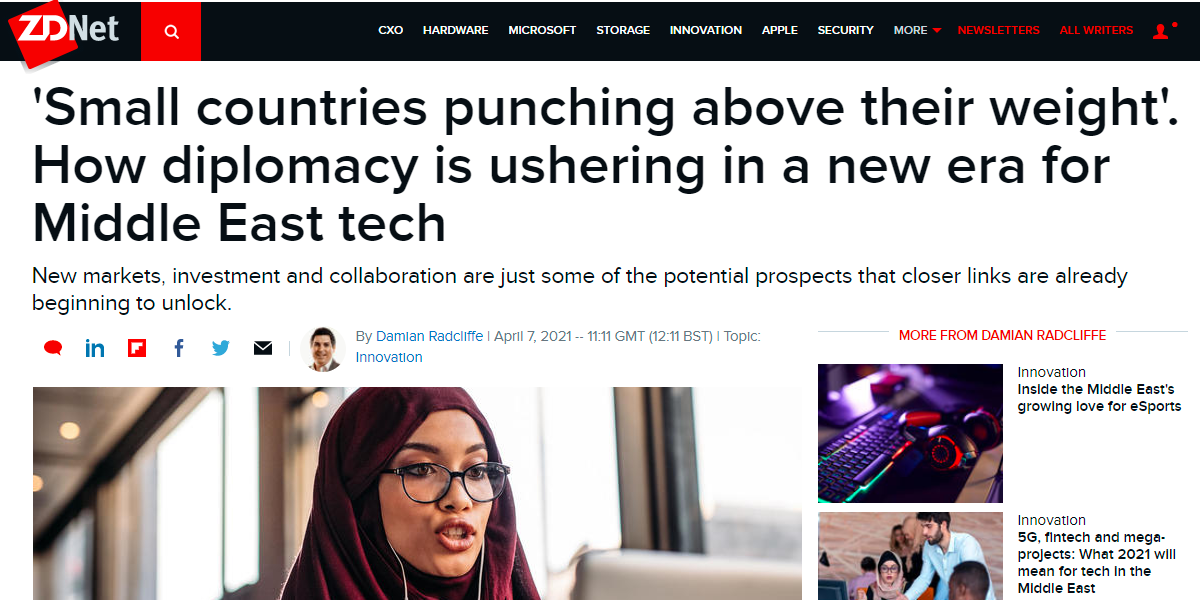
UAE innovation plans stand to gain from Israel significantly via collaborations following the historic Abraham Accords signed last year. I volunteered a few of my views on the matter to ZDNet’s Damian Radcliffe for his article on ‘how diplomacy is ushering in a new era for Middle East tech‘, which gathers opinion on the Accords impact on the technology sector from Bahrain, Israel, the United Arab Emirates and the US.

I believe that the UAE’s new relationship with Israel, offers technology sectors in both countries enormous opportunities. As the UAE continues to put in policies and incentives to encourage home-grown innovation and attract global tech talent, it can now draw on some of the resources and expertise that have helped Israel to scale its startup ecosystem. Likewise, the growing number of UAE investors interested in early-stage venture capital deals, can learn a lot from their Israeli counterparts.

From the outset, the engagement of Israeli tech firms with the UAE has been enthusiastic, to say the least. Many in the UAE’s technology industry were contacted by dozens of Israeli technology companies in the weeks following the signing of the Abraham Accords. I was personally contacted by more than a hundred members of the Israeli technology sector in the 3-4 weeks following the Accords and conducted dozens of market briefings for startups, investors and technology exporters. We’ve since seen thousands of Israelis fly to the UAE, many of them also from its tech sector and startup ecosystem, not to mention a few high profile deals.

Beyond the initial ‘gold rush’, it remains to be seen how Israeli and UAE technology sectors will invest in each other, compete against one another and collaborate together. However, overall, it seems likely that UAE innovation plans will benefit from the additional technology focus, knowledge and investment inspired by the country’s new relations with Israel.

You can read Damian’s full article on the Abraham Accords impact on the Middle East tech sector here.